
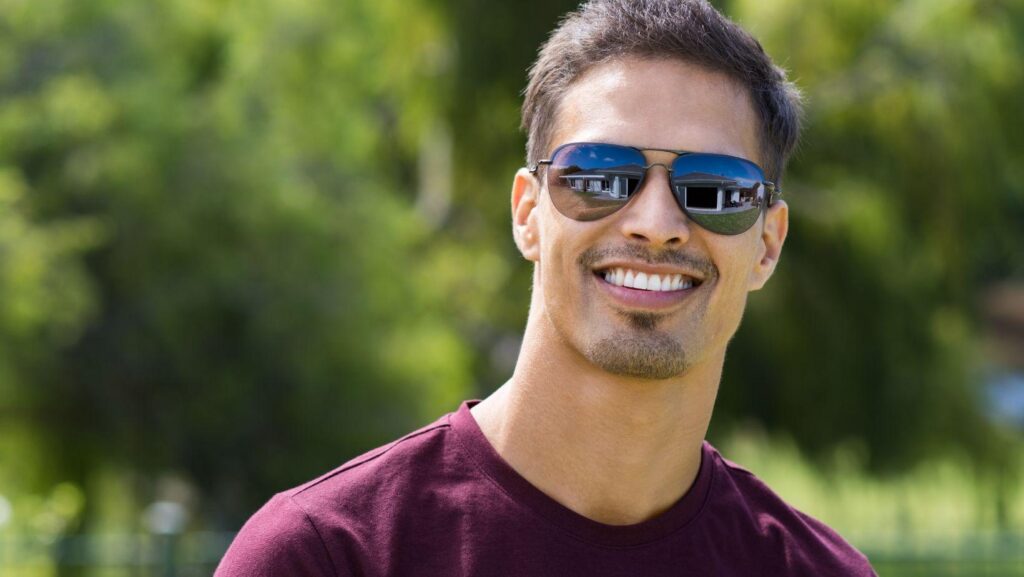
Shopping for men’s sunglasses used to be a five-minute decision at a gas station spinner rack. Grab a pair of black wayfarers, pay eight bucks, drive off. That era is mostly gone. Optometrists have gotten louder about UV damage to the cornea and retina, athletes have gotten pickier about lens tints, and the sheer number of frame shapes and price tiers has ballooned to the point where a first-time buyer can freeze up in front of a wall at Sunglass Hut.
Three questions usually get someone unstuck. What does the face look like. What are the shades actually going to do all day. And what kind of light do they need to handle.
Frame shape is the first filter, not the last
Most guides bury frame fit under color and brand. That is backwards. A pair of sunglasses that sits wrong on the nose or pinches at the temples will get left in a drawer no matter how good the lens is.
Face shape guidance has been around forever, and the basic rule holds up. Angular frames flatter round faces. Rounder frames soften square jaws. Aviators tend to work on oval faces because ovals are the neutral canvas that takes almost anything. Heart-shaped faces, wider at the brow and narrower at the chin, usually do well with a frame that is wider at the bottom, which is why classic clubmasters keep coming back around every few years like a bad haircut that eventually looks good again.
The thing face-shape charts miss is head width. A large frame on a narrow head slides down the nose every ten minutes. A small frame on a broad head leaves red marks that last until dinner. Some brands have finally started publishing small/medium/large categories, which helps.
Practical checks before committing:
• The top of the frame should sit at or just below the brow line, not cover it.
• Temples should touch the head lightly in front of the ears, not press.
• The frame should not extend past the widest part of the face.
• When smiling hard, the cheeks should not push the frame up off the nose.
Most retailers now let shoppers filter by shape directly, which is worth using.
Lens color is doing more work than people think
Lens tint gets treated as a style choice. It is partly that. It is also an optical decision that changes how the world looks through the glass.
Grey lenses are the most neutral. Colors stay true, brightness drops evenly, and nothing gets weird when looking at a traffic light. Grey is the safe default for driving.
Brown and amber lenses boost contrast against green and blue backgrounds, which is why golfers gravitate toward them. The ball pops off the fairway and depth perception on longer putts improves.
Green lenses split the difference between the two. They preserve color reasonably well while adding a mild contrast bump. Ray-Ban’s original G-15 lens, developed for U.S. Air Force pilots in the 1930s, was green for exactly this reason.
Rose and red tints help in flat, overcast light. They sharpen edges when the sky is a dull sheet of grey, which is why they turn up in cycling and skiing lineups.
Yellow lenses are for low light. They filter blue wavelengths and boost perceived contrast, useful at dawn, dusk, or on foggy mornings. In bright sun they let too much light through and become a headache generator.
Mirrored coatings sit on top of any base tint and bounce additional light away. Useful on snow, water, and sand. Purely cosmetic on a cloudy Tuesday in November.
Polarization is a separate feature entirely, not a color. Polarized lenses cut horizontal glare bouncing off flat surfaces, which is why anglers swear by them. The tradeoff is that polarized lenses can make certain LCD screens hard to read, including some car dashboards.
Everyday shades versus high performance sunglasses
A pair meant to look sharp on a patio and a pair meant to stay put during a 10K are engineered differently, even when both get sold under the same category header.
A fashion-first frame usually uses acetate, a plant-based plastic that takes color beautifully and feels substantial in the hand. Acetate is heavier, does not grip during sweat, and can warp if left on a car dashboard in July. Fine for a frame that spends most of its life on a face at brunch. Less fine on a bike.
High performance sunglasses lean on lighter polymers like TR-90 or Grilamid, rubberized nose pads, and temple tips that get grippier when wet. Weight drops into the 20 to 30 gram range. Lenses are often shatter-resistant polycarbonate. Wraparound geometry increases peripheral coverage and blocks wind, which matters more than most casual wearers assume, since wind evaporates the tear film and causes that mid-run eye squint everyone recognizes.
The affordable performance category has gotten genuinely good over the last five years. Brands like Goodr built a following by pricing polarized, no-slip frames at a point where losing a pair on the trail is annoying but not ruinous. Oakley and Smith Optics still dominate the premium end, with lens tech like Prizm and ChromaPop that does what the marketing claims. The price reflects it.
Golfers and anglers should look specifically at optically corrected lenses, sometimes called decentered lenses, which reduce distortion at the edges of a wrapped frame. Cheap wraparounds can create a fisheye effect that throws off distance judgment. That is a real problem when reading a green.
Fit tests that take thirty seconds in a store
A frame that fits well disappears on the face. A frame that fits poorly is a low-grade distraction all day, the kind that ends with someone shoving the glasses up their nose every four minutes without noticing they are doing it.
Worth doing before the register:
Shake test. Put the frame on, look down at the floor, and shake the head side to side. If the sunglasses slide or bounce, they will slide or bounce on a run.
Smile test. Big exaggerated smile. If the frame lifts off the nose more than a couple millimeters, the fit is off.
Side gap check. Look in a mirror from the side. A large open triangle between the temple and the face means light leaking in, which defeats a lot of the point.
Pressure points. Wear the frame for three or four minutes in the store. Uncomfortable in five minutes means unwearable in an hour.
Price, warranties, and when to spend more
The honest answer on price: above roughly $25, lens quality on non-polarized frames plateaus quickly. UV protection is a coating question, and any reputable brand at any price point should hit 100 percent UVA and UVB blocking. That is separate from UV400, which refers to blocking wavelengths up to 400 nanometers and is a slightly stricter standard.
Where spending more actually shows up: polarization quality, lens clarity at the edges, hinge lifespan, and specialized tints like photochromic lenses that darken and lighten with ambient light. A $200 pair of golf-specific shades from a serious optics brand really will read a green better than a $30 pair. Whether that difference matters depends on how often the buyer plays.
Warranties are worth checking. Some brands replace lost or damaged frames for a small fee. Others cover manufacturing defects for a year and nothing else. For anyone hard on gear, the warranty can be the deciding factor between two otherwise identical options.
Building a small rotation instead of chasing one perfect pair
The single-pair strategy rarely holds up. One frame cannot handle a beach vacation and a snowy chairlift equally well, and pretending otherwise usually ends with a scratched lens and a bad tan line.
A reasonable starter kit for most guys is an everyday pair in a neutral shape with a grey or green lens, and a performance pair for sport with polycarbonate lenses and grippy temples. Add a dressier option if the wardrobe calls for it. Total spend can stay under $300 with smart choices, or climb past $1,000 with premium brands.
The best pair is the one that actually gets worn. Everything else is just inventory.